

Portugal has more than 13,000 public charging points installed across all major cities and towns, as well as along routes, making it one of the most EV-friendly European destinations. Not only is that an energy-efficient choice, but it is also a smart and economical choice for both local and international drivers.
This guide explains the types of EVs you can book based on the routes and the charging station availability over a unified network. Also, the common and reliable apps and tools that can be used to keep your electric car rental running throughout your journey.
🚘 Should You Rent an Electric Car in Portugal?
An EV rental in Portugal can be a great way to traverse between multiple attractions for most itineraries, but it might not be necessary for all of them.
The per-day costs for electric rentals can usually be more than those for petrol cars. Spending an extra €5–€15 per day on an EV may seem like a lot. But charging costs in Portugal are about 40–60% lower per kilometre than filling a petrol tank. And that fuel cost can be nearly zero if your hotel offers free charging (which is increasingly common).
EVs avoid congestion zone surcharges that apply to petrol vehicles in the city centres of Lisbon and Porto. Blue-marked designated EV parking bays. Some towns offer discounted or even free unlimited parking for electric cars, which further reduces costs over a week-long stay.
Opt for a petrol or hybrid for a trip in the rural areas of inner Alentejo and parts of central Portugal. These areas lack sufficient charging infrastructure, and the available points are sparsely located. Also, the logistics of planning charging stops may outweigh the savings if you’re renting for just two or three days with no fixed base.
⚡⛽ EV vs Petrol Car Rental in Portugal
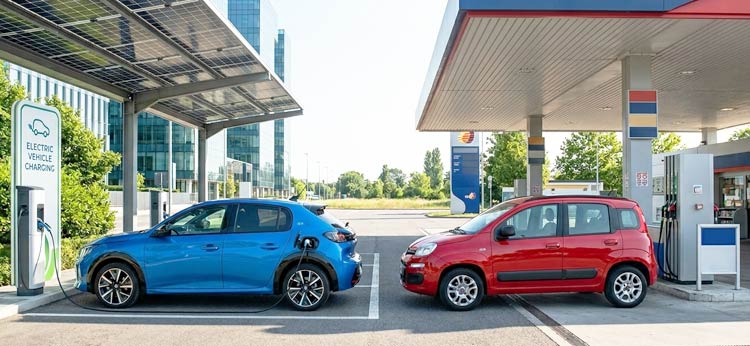
Use the following table for a quick comparison before you decide on a rental car to book for your trip to Portugal:
| Feature | Electric Car | Petrol Car |
| Daily rental rate | Slightly higher (€5–15/day more, on average) | Lower upfront |
| Fuel / Charging cost | 40–60% cheaper per km | €1.70–1.85/litre (petrol 95) |
| Weekly fuel cost (600–800 km trip) | ~€25–45 | ~€70–110 |
| Charging / Refuelling time | 20–40 min stop (DC fast); zero if hotel charges overnight | 5 min at any fuel station |
| Urban perks | Low-emission zone access; EV parking bays; free parking in some cities | May incur urban zone charges |
| Long rural drives | Requires planning in lower-density areas | Refuel anywhere with a fuel station |
🚗 Best Electric Cars to Rent in Portugal
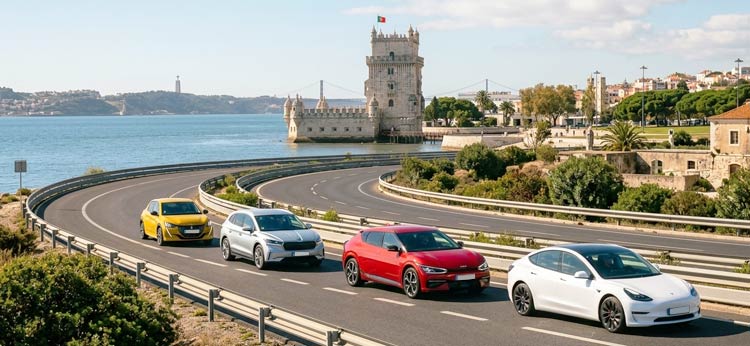
Portugal’s rental EV fleet has diversified considerably. An overview of available options and when they can be best used is provided for your reference:
| Model | Approx. Range | Fast Charge | Best For |
| Peugeot e-208 | 300–350 km | 100 kW | City, day trips |
| Volkswagen ID.3 | 420 km | 100 kW | City + day trips |
| Volkswagen ID.4 / Skoda Enyaq | 500 km | 135 kW | Families, road trips |
| Tesla Model 3/Y | 490–580 km | 250 kW | Long distance |
| Kia EV6 / Ioniq 5 | 500+ km | 230 kW | Fast charging priority |
How to Choose the Right EV in Portugal?
The best EV for your rental is the one that matches how you will actually travel. Below are some of the things to think through before booking:
☑️ Plan your itinerary first
Weigh up the longest single drive you will need to make in a day. And whether there’s an overnight charging option available at your accommodation.
Almost any EV (like the Peugeot e-208 or the VW ID.3) suffices for travel plans limited to a single city. Range is rarely an issue, as having a charging access near your hotel matters more.
But you would need a car with at least 400 km of real-world range for a multi-city road trip. That leads you to vehicles like the Tesla Model 3/Y or the Kia EV6/Ioniq 5, which also offer fast charging.
☑️ Knowing the difference between the rated and real range
The WLTP range quoted by manufacturers is based on tests done in controlled environments. But the highway driving speeds of 110–120km/hr and the country’s warm weather can cut the real-world range by around 15-25%. A car may average 380–420 km in real-world driving conditions despite a 500 km WLTP rating.
This is where the Tesla Model 3 and the EV6/Ioniq 5 easily cover a ~280 km drive from Lisbon to the Algarve without stopping to charge. But a smaller EV would need a top-up on that same journey.
☑️ Consider who you are travelling with
Couples or solo travellers can choose between the VW ID.3 and the Peugeot e-208. These are easy to manoeuvre in narrow streets and to park, and have low running costs. Neither compromises on comfort for two people.
Families with children can opt for a VW ID.4 or Skoda Enyaq. Both offer proper rear legroom and boot space for luggage and beach gear. Not to mention the range to handle a full travel day without stressing about charging. The Kia EV6 is another sensible option if maintaining speed on driving days matters.
The Tesla Model 3/Y and the Kia EV6/Ioniq 5 are the standout choices for road trippers who want to maximise driving days. Since these vehicles support ultra-fast charging in under 15–20-minute stops at a highway, you spend less time at chargers and more time moving.
☑️ Charging speed is key
Pay close attention to the car’s maximum DC charging speed, as well as its range, for trips that require over 250 km of driving per day. The VW ID.4 and Kia EV6 can reach 80% charge in 20-35 minutes. That can make a real-time difference for a week-long road trip with multiple charging stops.
☑️ Check for a Mobi.E card when picking up the car
Some suppliers may offer a charging card, but not all. Knowing whether your rental comes with an Mobi.E RFID card or Miio access before taking the keys can save you from last-minute hassle when you actually need to use the app in a motorway service area.
Pickup Locations with Best EV Rental Availability
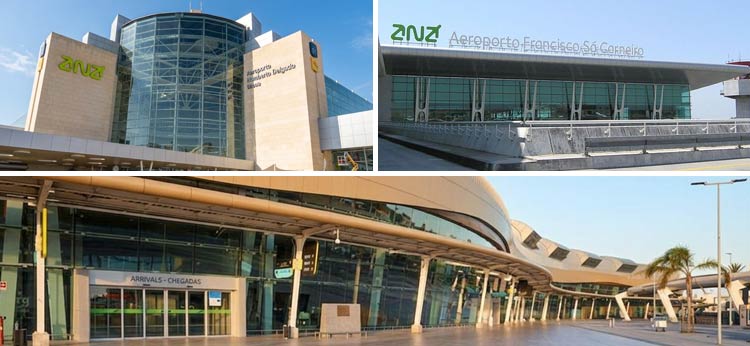
Portuguese cities/downtowns and train stations offer quick and easy pickup options for rental cars, but none offer as much availability of a variety of electric vehicles as the major airports do.
📍 Lisbon Airport (LIS) — Humberto Delgado
The Humberto Delgado airport has the largest EV selection of any Portuguese airport. Hertz, Europcar, SIXT, and Avis are major suppliers offering fully electric vehicles. Travellers can easily find popular models like Tesla 3/Y here. EV pickups may be processed differently from petrol cars, so you should confirm that with the supplier before arriving.
📍 Porto Airport (OPO) — Francisco Sá Carneiro
The EV availability here is slightly smaller than in Lisbon. But Volkswagen ID.3, ID.4, and Tesla Model Y are the most commonly available models travellers can book. Booking two weeks in advance is highly recommended to secure an electric vehicle at OPO during the summer season.
📍 Faro Airport (FAO) — Algarve
A growing EV fleet driven by high tourist demand and the Algarve’s strong eco-tourism positioning. The Volkswagen ID.4 and Jeep Avenger Electric are popular traveller choices offered by companies like Budget, Hertz and Goldcar. Since the FAO Airport is close to the Tesla Supercharger near Faro city, hiring a Tesla here is particularly convenient.
Useful Tip
Confirm at pickup whether an Mobi.E RFID card or Miio app access is included. Companies provide a charging card, though not all do. Knowing this before you collect the keys saves a potentially stressful first hour.
🛣️ Planning a Road Trip with an Electric Car
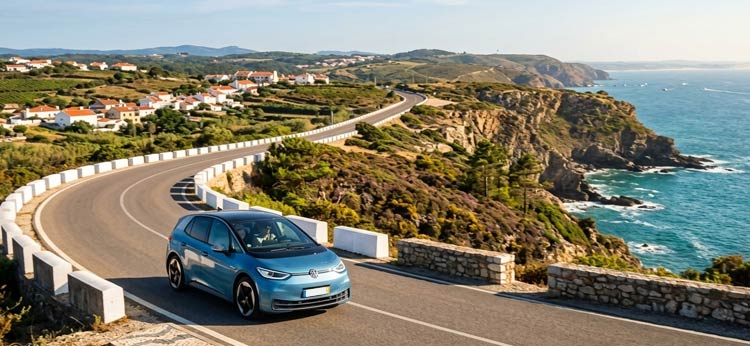
Portugal is a compact country with short distances between the main cities, making them easy to reach with any modern rental EV. All it takes is a bit of early planning to ensure a smooth travel experience. The following are some of the ways to help you do so:
Charging the vehicle to 80–90% each morning before driving. Plan a route around a single charging stop when driving over 250 km to get rid of range anxiety entirely.
Use the ABRP app to find optimal charging stops with timing and related information before each driving day. You can remove on-the-spot guesswork by knowing the route beforehand.
Use a fast DC charger at motorway service areas whenever possible. A coffee break takes 25-35 minutes, which is enough time for your car to charge and add 150-200 km of range.
Using a slow AC charger in your hotel car park or the shopping centre where you’d park anyway is cheaper than paying for a fast charger.
Top EV Road Trip Routes in Portugal
A quick glance at some of the most popular routes and the charging station availability, along with the distance you need to cover, is listed in the table below.
| Route | Distance | Charging Availability | Charging Tips | Highlights | Best EV Type |
| Lisbon → Sintra → Cascais | ~40–50 km | Excellent | Start fully charged from Lisbon; top up in Sintra/Cascais if below 60% | Pena Palace; Cascais seafront promenade | Any EV (low range OK) |
| Porto → Douro Valley | ~200 km (round trip) | Good | Charge fully in Porto; stop 30–40 mins in Régua (e.g. Pingo Doce car park) | Douro vineyards; Pinhão quintas; Casal de Loivos viewpoint | Mid/long-range EV (400+ km) |
| Faro → Lagos → Sagres | ~160 km | Moderate (fewer chargers near Sagres) | Charge to 80% in Lagos; confirm Sagres charger before departure | Ponta da Piedade cliffs; Algarve coastline | Mid-range EV (300–400 km) |
| Lisbon → Évora → Alentejo plains | ~300 km (round trip) | Limited beyond Évora (chargers spaced up to 80 km apart) | Leave Lisbon fully charged; verify Évora charger via Mobi.E | Roman Temple; Évora old town; Cromeleque dos Almendres | Long-range EV (400+ km) |
⚡ Charging Infrastructure in Portugal
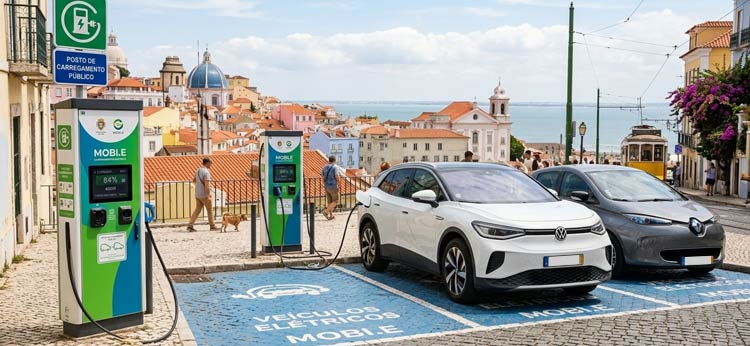
Portugal’s national electric mobility network, called Mobi.E, is the base for the country’s public charging infrastructure. It brings together thousands of charging stations from multiple operators into a single network.
All you need is an app or an access card from a registered mobility provider (CEME) to use almost any public charger in the country, regardless of which operator installed it. This makes Portugal significantly easier to navigate by EV than most European countries.
Where Can You Charge Your EV?
✔️ Lisbon
Over 300 public charging stations are available in parking spaces in shopping centres, underground garages, and on-street. Charging the car in any of these spots while you eat or sleep overnight at your hotel is practical. The coastal road to Cascais and Sintra is also well-served throughout.
✔️ Porto
More than 200 chargers are situated in malls, airports, and main streets. These are all closely installed, so it’s easy to top up during normal sightseeing. You will find chargers in the towns of Peso da Régua and Pinhão when driving east towards the Douro Valley. So, the wine country route is easy to navigate.
✔️ Algarve
The Algarve region of southern Portugal has reliable coverage of chargers near resorts, hotels, and beaches of towns like Faro and Lagos. The main A22 motorway has chargers located at regular intervals. The routes on the west coast cliff near Sagres have comparatively fewer charging options.
✔️ Highways
The A1 (Lisbon–Porto), A2 (Lisbon–Algarve), and A22 (Algarve east–west) routes have Via Verde Electric chargers at service stations located roughly every 40–60 km. These are typically 50 kW DC chargers that can provide a 20–30-minute top-up during a coffee break.
✔️ Alentejo and Rural Interior
The Alentejo is a must-visit region, but it lacks enough charging points, and those available are located as far as 80km apart. Towns like Évora, Beja, and Portalegre have chargers. Plan your charging stops before setting off on a long road trip across Alentejo. Do not rely on chargers unless you’re sure they’re fully functional. App updates for some of the chargers in rural locations may be slower.
Types of Chargers and Charging Costs
Standard and fast chargers have different speeds that amount to varying average charging costs, as given in the table below:
| Charger type | Approx. cost per kWh | Where You Will Find It | Notes |
| AC slow/normal (up to 22 kW) | €0.25–0.35 | Car parks, shopping centres, hotels | Cheapest; ideal for long stops |
| DC fast (50 kW) | €0.35–0.50 | Motorway service areas, urban fast-charge hubs | Most common for road trips |
| DC ultra-fast (100 kW+) | €0.45–0.55 | Ionity stations, expanding Mobi.E ultra-fast hubs | Some add a session fee of €0.50–1.00 |
| Ionity (ad hoc, no membership) | ~€0.75 | Motorways/highways, service stations/rest stops | Above average; use for speed, not savings |
| Tesla Supercharger (non-subscription) | €0.46–0.55 | Major highways, Tesla showrooms or service centres | Primarily available for Teslas |
| Hotel / free chargers | Often free | Hotel car parks | Confirm in advance; usually AC slow |
Connector Types
Type 2 (Mennekes) is a standard connector for AC charging. All AC chargers in Portugal use Type 2. Your rental car will have a compatible port. An AC cable is usually provided as well.
CCS (Combined Charging System) is a common DC fast charging connector. Most fast and ultra-fast chargers are tethered (with a built-in cable). So, you don’t need to carry one.
CHAdeMO is an older DC standard used by some older models. Uncommon in modern rental fleets, though a few public chargers may still support it.
Confirm if your car uses CCS for DC charging and that a Type 2 cable is in the boot at the time of pickup. If your rental is a Tesla, it most likely uses the same CCS port in Europe
Payment Methods
- An RFID card is the most common and reliable method. You register with an electricity supplier like EDP, Galp, or Miio, and receive a physical or digital card. Then simply tap it at any Mobi. E-connected charger to start a session. No app required at the charger itself.
- The Miio app is a great option for tourists, allowing them to find chargers, start sessions via QR code, and pay with a card. The app is certified by Mobi.E and does not require a physical RFID. One can easily sign up before travel; it takes only a few minutes to register.
- Quite a number of Mobi.E chargers support contactless bank card payments or QR-code-triggered sessions without an account. This option might not be available at all stations yet.
- Shell Recharge RFID cards (formerly NewMotion) also work across the Mobi.E network via roaming agreements. This is useful if you’re an existing Shell Recharge user from the UK or elsewhere in Europe.
- Ionity stations operate outside the Mobi.E platform. You would need a separate Ionity app or a roaming partner to charge an EV with a CCS port. These chargers are positioned along major motorways and offer ultra-fast charging (150–350 kW).
- Tesla Superchargers are not part of the Mobi.E network. An account is generally provided for rental Teslas, but sometimes travellers have to use the one linked to the car’s built-in payment system. It’s a common confusion that you should clarify before leaving the pickup location.
Apps & Tools to Find Charging Stations
Some common apps for locating EV charging points in Portugal are as follows. Download the apps before you start driving, instead of when you need to charge the vehicle.
Miio
Keep this as your primary charging app. It shows real-time availability of all Mobi.E chargers along with their upfront cost estimates. The app is free to download and supports direct card payment.
ZAPP / Mobi.E official app
The official national charger map. Useful for verifying station locations and checking real-time availability across the entire network. Less polished than Miio for actually starting sessions, but you can rely on the Mobi.E app for reference.
PlugShare
This app displays a charger database based on community reviews. Beneficial for checking whether a specific charger, especially those located in rural areas or smaller towns, is actually working and easy to access. User reviews often include photos and tips not found in the official PlugShare app.
A Better Route Planner (ABRP)
ABRP is highly recommended for longer drives, as the app suggests optimal charging stops along the route. Enter your destination, rental car model and its current battery level to view charging options. The app is more useful than Google Maps for EV road trips.
Chargemap or Electromaps
These are great backup apps for roaming travellers with other European charging cards.
How to Charge an Electric Vehicle in Portugal?
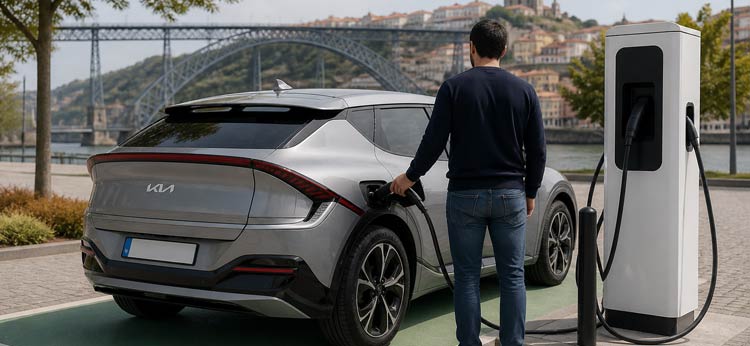
Charging an electric car in Portugal is simple, once you understand how the system works. The national Mobi.E platform connects every public charger into a single integrated network. Meaning that you can use a single app or card to access almost all stations operated by Galp, EDP, PowerDot, Iberdrola, PRIO, and others.
The three charger types that can be commonly found at these stations are:
- Normal AC (up to 22 kW) — ideal for overnight or extended stops; cheapest.
- Fast DC (50 kW) — located at motorway service areas and urban fast-charge hubs; standard road-trip top-up option.
- Ultra-fast DC (100–350 kW) — found at Ionity stations and Mobi.E ultra-fast hubs; most expensive but time saving.
Steps for Charging an EV
- Find a charger using the Miio or Mobi.E app.
- Park and connect the cable. Fast charger cables are generally fixed to the unit. Use the Type 2 cable from the car’s boot to connect to an AC charger.
- Tap your RFID card, scan the QR code with an app to start a charging session.
- The session starts automatically once authenticated. The car’s display and your app both confirm the session.
- Keep an eye on the charging level in the app, then disconnect the charger.
⁉️ Frequently Asked Questions
1️⃣ Can I use a contactless bank card to charge my EV rental in Portugal?
Yes. An ad hoc bank card payment can be used to charge your electric vehicle on the Mobi.E network in Portugal. The service may not be available at every station or location, as updates are still in progress. That’s why having a backup app like Miio besides a primary app is necessary.
2️⃣ Can non-Tesla rental cars use Tesla Superchargers?
No. Tesla Superchargers can only be used by Tesla vehicles in Portugal. For a non-Tesla EV, you can use Mobi.E fast chargers or Ionity stations for DC rapid charging. In some countries, these superchargers are now starting to be available for non-Tesla vehicles.
3️⃣ Is parking free for electric vehicles in Portugal?
Some of the Portuguese cities and municipalities offer discounted or free parking for electric vehicles in designated bays. This does not apply to all locations. In cities like Lisbon, fully electric vehicles (not hybrids) can be parked without a parking fee or time limit after obtaining a green sticker (via EMEL) for an annual fee of €12. You should avoid parking without confirming local regulations.
4️⃣ Do I need a special driving license to rent an electric car in Portugal?
A valid driving license from your home country is generally accepted by rental companies in Portugal. But you will need to provide an International Driving Permit (IDP) or an official English translation if your original driving license is issued in a non-Latin alphabet (eg, Chinese, Arabic, Cyrillic). The condition applies to both the main driver and any additional drivers listed in the contract.
5️⃣ Do I need to return an EV rental fully charged?
Not necessarily, as the required battery percentage depends on your chosen battery policy (much like the fuel policy for petrol or diesel cars). For most suppliers, an EV must be returned with at least 80% battery charge. Sometimes the required charge can be 100%. In any case, make sure you return the car with the same charge as specified in the agreement; otherwise, the supplier will charge a premium charging fee (at a higher per-kWh rate than public stations) at drop-off.
6️⃣ Which EV apps are used in Portugal?
Miio is a primary app for Mobi.E network access. PlugShare is useful for community reviews. Chargemap and Electroverse work for roaming users with European charging cards. A physical Shell Recharge RFID card can be used via roaming at most Mobi.E stations.
